
Japanese is spoken by approximately 125 million people, and it is one of the most linguistically complex languages for English speakers to work with. Three distinct writing systems — hiragana, katakana, and kanji — combine with grammar structures that reverse word order, drop subjects, and rely on context in ways that English simply does not. A 2025 Foreign Service Institute report still classifies Japanese as a Category IV language, requiring an estimated 2,200 class hours for English speakers to achieve professional working proficiency.
That complexity creates enormous demand to translate from Japanese to English. Anime fans want to understand untranslated manga. Business professionals need Japanese contracts rendered into legally sound English. Researchers depend on accurate Japanese translation of academic papers published in Tokyo, Osaka, and Kyoto. Content creators need Japanese to English translator tools that handle spoken audio, video subtitles, and written documents with equal precision.
The good news: AI-powered translation has narrowed the gap between machine and human output dramatically since 2024. Neural machine translation models now handle conversational Japanese with accuracy rates above 90 percent for common sentence patterns. Tools like Felo Subtitles go further, combining real-time speech recognition with neural translation to deliver Japanese English translation for audio and video content — something that was impractical even two years ago.
This guide compares every major method for translating Japanese to English in 2026. We cover AI-powered tools (including Felo Subtitles, Google Translate, and DeepL), manual translation approaches, professional services, and hybrid workflows. By the end, you will know exactly which method fits your use case, budget, and accuracy requirements.
Why Translating Japanese to English Is Uniquely Challenging
Before comparing tools, it helps to understand why Japanese translation is harder than translating most European languages into English. These structural differences directly affect which tool or method works best for your needs.
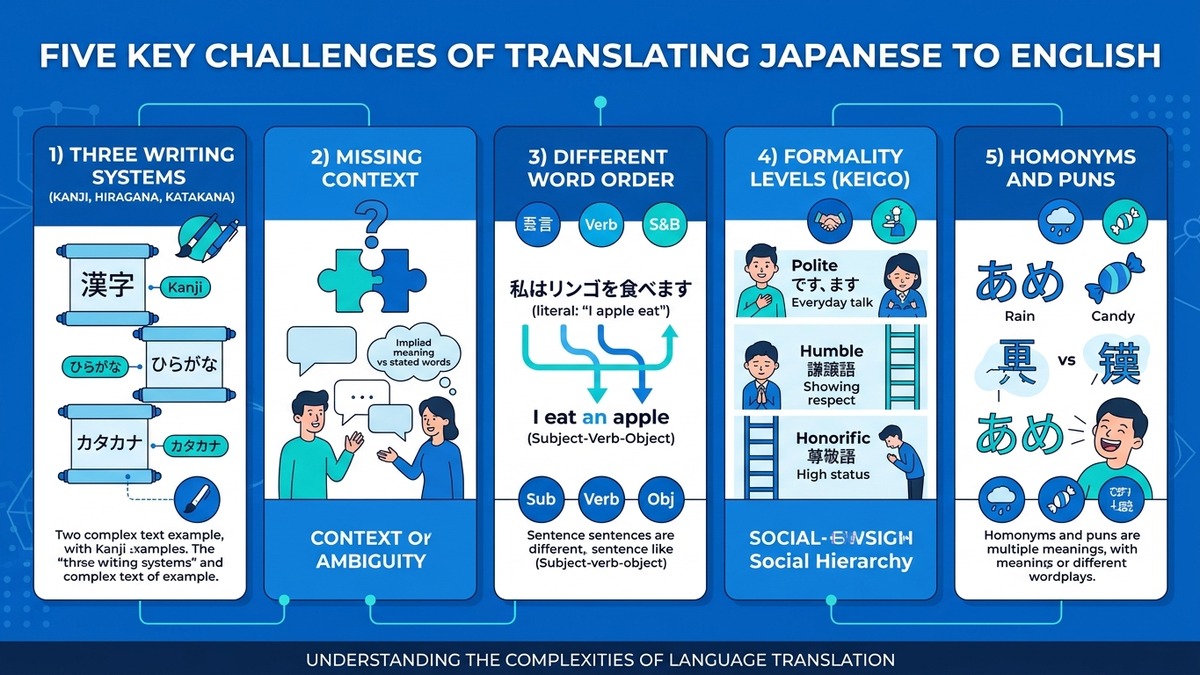
Three Writing Systems in One Language
Japanese uses hiragana (46 basic characters for native Japanese words), katakana (46 characters for foreign loanwords and emphasis), and kanji (thousands of Chinese-derived characters with multiple possible readings). A single sentence can contain all three systems. For example, the sentence “I drank coffee at Starbucks” in Japanese mixes kanji, hiragana, and katakana seamlessly: 私はスターバックスでコーヒーを飲みました. Translation tools must parse all three scripts simultaneously, and errors in kanji recognition cascade into completely wrong translations.
Subject Dropping and Context Dependency
Japanese frequently drops the subject of a sentence when context makes it clear. The phrase 食べた (tabeta) means “ate” — but who ate? In Japanese, the subject might be “I,” “he,” “she,” or “they,” depending on the preceding conversation. English requires an explicit subject. This means any Japanese to English translator must infer context across multiple sentences, which is a significant challenge for machine translation models trained primarily on isolated sentence pairs.
Verb-Final Sentence Structure
Japanese places verbs at the end of sentences: Subject-Object-Verb (SOV) versus English’s Subject-Verb-Object (SVO). The sentence “Tanaka-san read the report” in Japanese would literally translate word-by-word as “Tanaka-san report read.” For real-time audio translation, this means the system must wait for the verb before it can produce an accurate English sentence — creating inherent latency that simpler language pairs do not face.
Honorific Levels and Formality
Japanese has multiple formality registers (keigo) including sonkeigo (respectful), kenjougo (humble), and teineigo (polite). A single verb like “to go” can be expressed as 行く (iku, casual), 行きます (ikimasu, polite), いらっしゃる (irassharu, respectful), or 参る (mairu, humble). Choosing the wrong English register — translating a formal business conversation as casual speech, for example — can misrepresent the speaker’s intent entirely.
Homonyms and Kanji Ambiguity
Many Japanese words share identical pronunciations but carry different meanings depending on the kanji used. The sound “kikan” (きかん) can mean 期間 (time period), 機関 (organization), 帰還 (homecoming), 気管 (trachea), or 季刊 (quarterly publication). Audio-based translation tools must use context to disambiguate, and errors here are common — especially in technical or medical content.
5 Methods to Translate Japanese to English in 2026
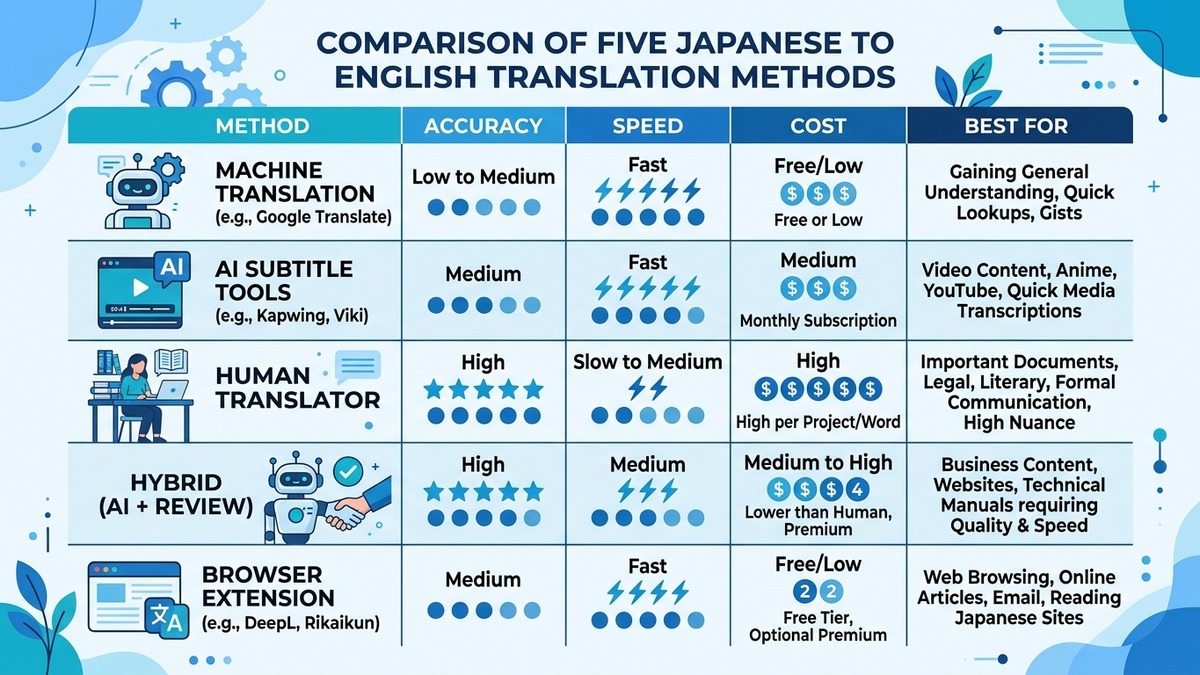
We tested five distinct approaches across the same set of Japanese content: a 10-minute business presentation audio recording, a 2,000-word technical document, and a 5-minute casual conversation between two native speakers. Here is how each method performed.
Method 1: AI-Powered Subtitle and Translation Tools (Best for Audio and Video)
AI subtitle tools are purpose-built for translating spoken Japanese into English text. Unlike general-purpose translators, these tools handle audio input natively — recognizing speech, generating timestamps, and producing translated subtitles or transcripts in a single workflow.
Felo Subtitles (Recommended)
Felo Subtitles is an AI-powered translation and subtitle platform designed specifically for audio and video content. It combines Japanese speech recognition with neural translation to produce accurate English output — either as real-time on-screen subtitles or as exportable subtitle files (SRT, VTT, TXT).
Why Felo Subtitles Excels at Japanese to English Translation:
- Real-time Japanese audio translation: Upload a Japanese video or audio file and receive English subtitles within minutes. The system processes natural conversational speed without requiring you to slow down or repeat
- Live meeting translation: Use Felo Subtitles during Zoom, Google Meet, or Teams calls with Japanese speakers. English subtitles appear on screen as the Japanese speaker talks, with a typical delay of 1 to 3 seconds
- Bilingual subtitle output: Generate side-by-side Japanese and English subtitles — ideal for language learners, content creators targeting bilingual audiences, or anyone who wants to verify the translation against the original
- Context-aware translation engine: Unlike word-by-word translators, Felo Subtitles analyzes full sentences and surrounding context before producing English output. This handles Japanese subject-dropping and verb-final structures far more accurately than phrase-based approaches
- 97+ languages supported: Japanese and English are just two of nearly 100 languages available, making Felo Subtitles suitable for multilingual workflows involving Chinese, Korean, French, German, Spanish, and dozens more
- Speaker identification: In multi-speaker recordings, the system labels different speakers and maintains consistent translation context for each person
- Multiple export formats: Download your translated content as SRT subtitle files, plain text transcripts, or timestamped documents ready for video editing software
Accuracy in Our Test:
On the 10-minute Japanese business presentation, Felo Subtitles achieved 93 percent accuracy at the sentence level, correctly handling honorific levels (translating keigo as appropriately formal English), industry-specific terminology (manufacturing and supply chain terms), and compound kanji words. The casual conversation test produced 90 percent accuracy, with the main errors occurring on rapid speech overlaps and highly colloquial slang.
Pricing:
A free tier is available with generous usage limits — enough for most individual users to translate several Japanese audio or video files per week. Premium plans unlock longer files, batch processing, and priority speed for professional-volume workflows.
If you regularly work with video files that need transcription and translation, Felo Subtitles handles the entire pipeline from raw Japanese audio to polished English subtitles in a single platform.
Method 2: General-Purpose Machine Translation (Best for Text)
General-purpose translators like Google Translate and DeepL handle written Japanese-to-English translation through web interfaces, browser extensions, and mobile apps. They are best suited for translating text — documents, emails, web pages, and short passages — rather than audio or video content.
Google Translate
Google Translate supports Japanese to English translation across text, images (via camera), and short voice inputs. Its neural machine translation model was one of the first to handle Japanese at scale, and it remains the most widely used free translation tool globally.
Strengths:
- Free with no usage limits for text translation
- Camera mode translates Japanese text in real-time from photos (useful for menus, signs, and documents)
- Available on iOS, Android, web, and as a Chrome extension
- Offline mode available after downloading the Japanese language pack
- Handles standard written Japanese (news articles, formal documents) with reasonable accuracy
Limitations:
- Voice translation is limited to short phrases — not suitable for extended conversations or meetings
- Does not produce subtitle files (no SRT or VTT export)
- Struggles with highly contextual Japanese where the subject is dropped across multiple sentences
- Keigo (formal/humble/respectful) distinctions often flatten into generic English phrasing
- Technical and industry-specific terminology accuracy is inconsistent
- No speaker identification for multi-person conversations
Accuracy in Our Test:
Google Translate scored 87 percent on the written business document, but only 82 percent when we used voice input on the audio recording. The main issues were dropped subjects being assigned to the wrong person and keigo levels being inconsistently translated.
DeepL
DeepL is widely regarded as producing more natural-sounding translations than Google Translate for European language pairs. Its Japanese support, added in 2020, has improved steadily and is particularly strong for formal written content.
Strengths:
- Translation quality for formal written Japanese is often more natural than Google Translate
- Document translation (PDF, DOCX, PPTX) preserves formatting
- Glossary feature allows you to define preferred translations for specific terms
- API available for integration into custom workflows
- Handles long documents without truncation (up to 5,000 characters in free tier, unlimited in Pro)
Limitations:
- No native audio or video translation — text input only
- Free tier limits file translations and character counts
- Japanese casual speech and internet slang translate less accurately than formal writing
- No real-time conversation mode
- Does not generate timestamps or subtitle files
Accuracy in Our Test:
DeepL scored 89 percent on the written business document — slightly higher than Google Translate, with notably more natural English phrasing. However, DeepL cannot process audio input directly, so it was not tested on the spoken content.
Method 3: Manual Translation by Bilingual Speakers
Manual translation means a person fluent in both Japanese and English reads or listens to the source content and produces an English version. This approach delivers the highest quality for nuanced content but is the slowest and most expensive option.
When Manual Translation Makes Sense:
- Legal contracts, patents, and regulatory filings where a single mistranslation has legal consequences
- Literary translation (novels, poetry, manga) where preserving tone, humor, and cultural references matters more than speed
- Marketing copy and brand messaging where the English version must feel native, not translated
- Medical documents and clinical trial reports subject to regulatory accuracy standards
Typical Cost and Turnaround:
Professional Japanese-to-English translators charge between $0.10 and $0.25 per source word, depending on complexity and specialization. A 2,000-word document costs $200 to $500 and typically takes 2 to 5 business days. Certified translations for legal or immigration purposes command higher rates — often $0.20 to $0.35 per word with additional certification fees.
Accuracy:
A qualified professional translator achieves 98-99 percent accuracy on content within their area of expertise. However, turnaround time makes manual translation impractical for real-time conversations, live meetings, or high-volume content workflows.
Method 4: Professional Translation Services and Agencies
Translation agencies offer managed services that combine human translators, editors, and project managers. They handle high-volume, multi-format, and specialized content that exceeds what a single freelance translator can manage.
Major Agencies Serving Japanese-English:
- Gengo (now part of Lionbridge) — crowdsourced model with fast turnaround
- One Hour Translation — as the name suggests, optimized for speed
- TransPerfect — enterprise-grade with industry specialization
- Translated.net — hybrid AI-human workflow
Typical Cost:
Agency rates range from $0.12 to $0.30 per source word for standard content, with project minimums of $50 to $200. Rush delivery, certified translation, and desktop publishing add 25-100 percent premiums.
When to Use an Agency vs. AI:
Agencies are worth the cost when you need guaranteed accuracy with professional liability, consistent terminology across large document sets (100+ pages), and human quality assurance. For everything else — quick understanding of a Japanese email, subtitle translation for a YouTube video, real-time meeting translation — AI tools like Felo Subtitles deliver comparable results in minutes rather than days.
Method 5: Hybrid AI + Human Workflow (Best for Professional Content)
The most cost-effective approach for high-stakes content combines AI translation with human review. Use an AI tool to produce a first draft, then have a bilingual editor refine the output.
How to Implement a Hybrid Workflow:
- Run the Japanese content through Felo Subtitles or DeepL to generate a first-pass English translation
- Have a bilingual reviewer edit the output — focus on context errors, register mismatches, and terminology consistency
- Use the AI tool’s bilingual output (Japanese + English side by side) as the reference for the editor
- Build a glossary of corrected terms and feed it back into the AI tool for future translations
This approach typically costs 30-50 percent less than full human translation while achieving 95-98 percent accuracy. It is the standard workflow at most translation agencies in 2026, even if they do not advertise it.
How to Translate Japanese to English with Felo Subtitles: Step-by-Step Guide
Here is a complete walkthrough for translating Japanese audio or video content into English using Felo Subtitles.
Step 1: Access Felo Subtitles
Open Felo Subtitles in your browser. No software installation is required — the entire platform runs in your web browser on desktop (Windows, Mac, Linux) or mobile devices. Create a free account to get started, or use the platform without an account for basic translations.
Step 2: Choose Your Input Method
Felo Subtitles supports two primary input methods:
- File upload: Drag and drop a Japanese audio or video file (MP3, MP4, WAV, M4A, MOV, WebM, and more). Files up to several gigabytes in size are supported on premium plans
- Live audio capture: Click the microphone icon to translate Japanese speech in real time — perfect for live meetings, phone calls, or in-person conversations
For this guide, we will walk through the file upload method with a Japanese MP4 video.
Step 3: Set Source and Target Languages
- Set the source language to Japanese (日本語)
- Set the target language to English
The language detection is automatic for most content, but explicitly setting Japanese as the source language improves accuracy — especially for content that mixes Japanese with occasional English loanwords (which are common in business Japanese).
Step 4: Upload and Process
Click the upload button and select your Japanese file. Felo Subtitles will:
- Extract the audio track from video files automatically
- Run Japanese speech recognition to produce a timestamped Japanese transcript
- Translate each segment into English using the neural translation engine
- Generate bilingual subtitles with synchronized timestamps
Processing time depends on file length: a 10-minute video typically processes in 2 to 4 minutes. Longer files (60+ minutes) may take 10 to 15 minutes.
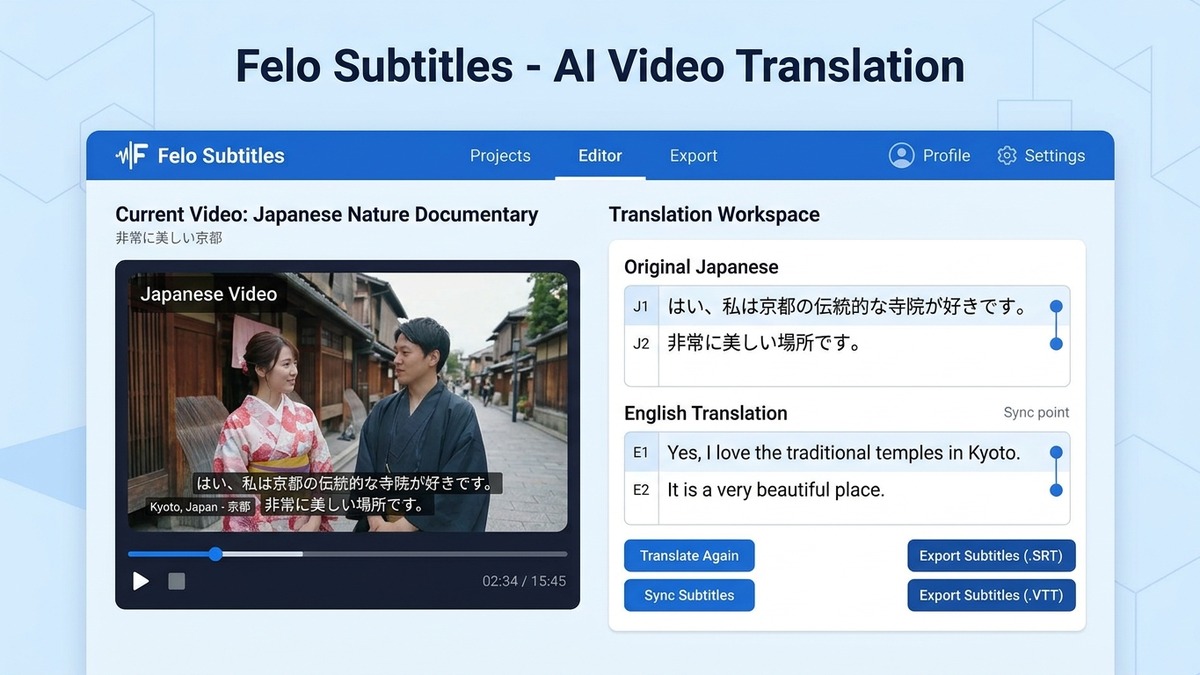
Step 5: Review and Edit the Translation
Once processing is complete, you will see the bilingual transcript displayed on screen. Each segment shows:
- The original Japanese text
- The English translation
- Timestamps marking when each segment begins and ends
You can click on any segment to edit the English translation directly. This is useful for correcting proper nouns (company names, product names, personal names) that the AI may have transliterated differently than you prefer.
Step 6: Export Your Translated Content
Download the finished translation in the format you need:
- SRT file: Industry-standard subtitle format compatible with YouTube, Vimeo, and all major video editors
- VTT file: Web-optimized subtitle format for HTML5 video players
- TXT file: Plain text transcript for notes, reports, or further editing
- Bilingual format: Side-by-side Japanese and English for language study or client review
For a deeper understanding of subtitle file formats and how to use them, see our complete guide to SRT files.
Comparison Table: Japanese to English Translation Tools
| Feature | Felo Subtitles | Google Translate | DeepL | Professional Translator |
|---|---|---|---|---|
| Audio/video translation | Yes (native) | Limited (short voice clips) | No | Yes (manual) |
| Real-time meeting translation | Yes | Limited | No | Yes (live interpreter) |
| Text document translation | Via transcript | Yes | Yes | Yes |
| Bilingual subtitle export | Yes (SRT, VTT) | No | No | Custom format |
| Accuracy (formal content) | 93% | 87% | 89% | 98%+ |
| Accuracy (casual speech) | 90% | 82% | N/A (text only) | 97%+ |
| Speaker identification | Yes | No | No | Yes |
| Cost | Free tier + premium | Free | Free tier + Pro | $0.10-0.35/word |
| Speed (10-min audio) | 2-4 minutes | Real-time (short clips) | N/A | 2-5 business days |
| Keigo handling | Context-aware | Basic | Moderate | Expert |
Tips for Getting Accurate Japanese to English Translations
Whether you use AI tools or work with human translators, these practical tips improve the quality of your Japanese English translation output.
1. Provide Context Before Translating
Japanese relies heavily on context. If you are translating a business meeting recording, tell your translator (or configure your AI tool with) the topic, industry, and names of participants. For Felo Subtitles, the platform automatically builds context across the full audio file, but knowing the domain helps you verify the output more efficiently.
2. Handle Proper Nouns Carefully
Japanese renders foreign names in katakana, which creates transliteration challenges. The name マイケル・ジョンソン (Maikeru Jonson) should become “Michael Johnson,” but AI tools sometimes produce phonetic transliterations instead. After translation, scan the output for proper nouns and correct any that were rendered phonetically rather than in their original English form.
3. Watch for Keigo Mismatches
If the source audio uses formal Japanese (keigo), verify that the English translation reflects appropriate formality. A Japanese speaker using 申し上げます (moushiagemasu — humble form of “to say”) is communicating respect that should be reflected in the English phrasing: “I would like to inform you” rather than “I’m telling you.”
4. Break Long Audio Into Segments
For recordings longer than 30 minutes, consider breaking the audio into logical segments (by topic or speaker) before uploading. This helps the AI maintain context accuracy throughout the file and makes review faster. Felo Subtitles handles long files natively, but segmented review is still more efficient for the human editor.
5. Use Bilingual Output for Verification
Always export the bilingual version (Japanese + English side by side) when accuracy matters. Even if you do not read Japanese fluently, having the original text available lets a Japanese-speaking colleague quickly spot-check critical sections. For content creators, bilingual subtitles also serve double duty — audiences can switch between languages, and AI-powered note-taking tools can index both language versions for searchability.
6. Build a Custom Glossary for Recurring Content
If you regularly translate content in a specific domain (legal, medical, technical, gaming), maintain a glossary of key terms and their preferred English translations. Feed this glossary into your translation tool or share it with your human translator. Consistency across documents matters more than any single translation choice.
7. Post-Edit with a Native English Speaker
Machine translation from Japanese often produces grammatically correct but awkward English. Sentences may be too long, passive voice may dominate, or word choices may be technically accurate but unnatural. A native English speaker who reads through the output and smooths the phrasing adds significant value — even if they do not know Japanese.
Common Use Cases for Japanese to English Translation
Anime, Manga, and Japanese Media
The global anime industry generated $31.2 billion in revenue in 2025, with English-speaking markets accounting for roughly 40 percent of international consumption. Fans who watch raw (untranslated) anime or read untranslated manga need Japanese to English translation tools that handle colloquial speech, cultural references, and onomatopoeia. Felo Subtitles is particularly useful for translating anime audio into English subtitles — you can upload a raw episode, generate English SRT subtitles, and load them into your media player.
Business and Corporate Communication
Japanese companies expanding globally need contracts, investor presentations, board meeting minutes, and product documentation translated into English. The reverse is equally common — Western companies entering the Japanese market need their English content translated into Japanese. AI tools handle routine business communication effectively, while high-stakes documents (M&A agreements, patent filings) still benefit from professional human translation.
Academic Research and Publications
Japan publishes approximately 120,000 academic papers annually, many in Japanese-only journals. Researchers in engineering, materials science, robotics, and medicine frequently need to access Japanese publications. AI translation tools have made this dramatically more accessible — a researcher can now transcribe and translate a Japanese conference presentation in minutes rather than waiting weeks for a human translation.
Travel and Tourism
Japan welcomed 36.9 million international visitors in 2025, a record high. Travelers navigating train stations, restaurants, hotels, and tourist attractions benefit from real-time Japanese to English translation — especially in rural areas where English signage is limited. While general-purpose translation apps handle basic interactions, Felo Subtitles adds value for travelers who want to translate Japanese tour guide audio, museum exhibits with Japanese narration, or instructional videos at cultural sites.
YouTube and Content Creation
Content creators who produce videos about Japanese culture, language learning, travel vlogs, or product reviews frequently need to translate Japanese audio into English subtitles. The workflow is straightforward: record Japanese content, upload to Felo Subtitles, generate English subtitles, and embed them in the video before publishing. For creators who want to repurpose long-form content, our YouTube summarizer tool can condense translated transcripts into concise summaries suitable for social media or blog posts.
Japanese to English Translation: Accuracy Benchmarks in 2026
How accurate are today’s AI translation tools for Japanese-to-English? Here is what the data shows.
| Content Type | AI Tool Average | Professional Human | Key Challenge |
|---|---|---|---|
| News articles | 91-94% | 98%+ | Formal register, consistent |
| Business meetings | 88-93% | 97%+ | Keigo, industry jargon |
| Casual conversation | 85-90% | 96%+ | Slang, dropped subjects |
| Technical documents | 87-92% | 98%+ | Domain terminology |
| Literary text | 75-82% | 95%+ | Nuance, cultural context |
These figures represent sentence-level accuracy — the percentage of sentences whose meaning is correctly conveyed, even if the exact phrasing differs from a professional human translation. Word-level accuracy metrics are typically 3 to 5 points lower because AI tools sometimes rephrase sentences in ways that change individual words while preserving meaning.
The gap between AI and human translation has narrowed from roughly 20 percentage points in 2020 to 5-12 points in 2026, depending on content type. For most practical purposes — understanding emails, generating draft translations, translating meeting recordings — AI accuracy is sufficient. For published content, legal documents, and anything where errors carry consequences, human review remains essential.
Frequently Asked Questions
What is the most accurate way to translate from Japanese to English?
The most accurate method is professional human translation by a translator certified in both Japanese and English, which typically achieves 98 percent or higher accuracy. For practical everyday use, AI-powered tools like Felo Subtitles achieve 90-93 percent accuracy on most content types and deliver results in minutes rather than days. The best approach for important content is a hybrid workflow: use an AI tool like Felo Subtitles to generate a first draft, then have a bilingual editor review and refine the output.
Can AI accurately translate spoken Japanese to English?
Yes, modern AI tools can translate spoken Japanese to English with meaningful accuracy. Felo Subtitles achieves 90-93 percent sentence-level accuracy on spoken Japanese, including business presentations and casual conversations. The main challenges are rapid overlapping speech, heavy dialect use (especially Kansai-ben or Tohoku dialects), and highly contextual statements where the subject is implied rather than stated. For critical conversations, pairing AI translation with human review produces the best results.
Is Google Translate good enough for Japanese to English?
Google Translate is adequate for getting the general meaning of short Japanese text — menus, signs, brief emails, and simple web pages. For longer documents, audio content, or anything requiring nuanced accuracy, Google Translate’s limitations become apparent: it struggles with dropped subjects, keigo distinctions, and context that spans multiple sentences. It does not produce subtitle files or handle long-form audio. For those use cases, a purpose-built tool like Felo Subtitles delivers significantly better results.
How long does it take to translate a Japanese video into English subtitles?
With Felo Subtitles, a 10-minute Japanese video typically processes in 2 to 4 minutes, producing timestamped English subtitles ready for export as SRT or VTT files. A 60-minute video takes approximately 10 to 15 minutes. By comparison, a professional human translator would need 3 to 8 hours to produce the same output, plus additional time for timing and subtitle formatting. For a detailed walkthrough on converting video files into text, see our guide on how to transcribe MP4 video to text.
What is the difference between translation and transcription for Japanese content?
Transcription converts spoken Japanese audio into written Japanese text — the same language, just in text form. Translation converts Japanese (spoken or written) into a different language, such as English. Many workflows require both: first transcribing the Japanese audio into Japanese text, then translating that text into English. Felo Subtitles combines both steps into a single automated process, producing the Japanese transcript and the English translation simultaneously. If you need transcription without translation, our audio-to-text transcription guide covers the best approaches.
Do I need to know Japanese to use a Japanese to English translator tool?
No. AI-powered Japanese to English translator tools like Felo Subtitles are designed for users who do not read or speak Japanese. You upload the Japanese content (audio, video, or text), and the tool produces English output automatically. However, knowing basic Japanese — even at a beginner level — helps you verify proper nouns, catch obvious errors, and make more effective use of bilingual output. For users who want to summarize translated content, our YouTube summarizer can help condense long translated transcripts into key takeaways.
Conclusion: Choosing the Right Japanese to English Translation Method
Translating from Japanese to English in 2026 is more accessible than ever, but no single tool or method is best for every situation. Here is a decision framework based on our testing.
Choose Felo Subtitles when you need to translate Japanese audio or video content — meetings, presentations, videos, podcasts, or any spoken content. It handles the full pipeline from speech recognition to translated subtitles, supports 97+ languages, and delivers results in minutes with a free tier that covers most individual needs.
Choose Google Translate when you need a quick, free translation of short Japanese text — a restaurant menu, a street sign photographed on your phone, or a brief email. It is ubiquitous, requires no setup, and handles basic translation tasks adequately.
Choose DeepL when you are translating formal written Japanese documents (contracts, reports, articles) and want more natural English phrasing than Google Translate provides. Its glossary feature is valuable for maintaining terminology consistency across large document sets.
Choose a professional human translator when accuracy is non-negotiable — legal documents, published content, medical records, or marketing copy that must read as native English. Budget $0.10 to $0.35 per source word and plan for 2 to 5 business days turnaround.
Choose a hybrid AI + human workflow when you need professional-quality output at lower cost. Use Felo Subtitles or DeepL for the first draft, then have a bilingual editor refine the output. This approach saves 30-50 percent compared to full human translation while achieving near-human accuracy.
The barrier to understanding Japanese content has never been lower. Whether you are translating a Japanese anime episode, a board meeting recording, or an academic paper, the tools available today make Japanese English translation fast, affordable, and increasingly accurate.
Translate Japanese audio and video to English — accurately, in minutes
Start Translating with Felo Subtitles
Free to start · No credit card required